
Last Updated: October 30, 2026
Quick Summary
To identify greenwashing in baby brands, treat vague words like natural, eco-friendly, and sustainable as marketing rather than facts, since none have a legal definition in baby clothing. Check for a named certifier and certificate number, then confirm that number in the certifier’s public directory before trusting any seal.
- Green packaging, leaves, and woodland animals signal safety without proving it.
- A leaf icon with no program name is not a certification.
- GOTS covers organic fiber content and processing for textiles like clothing and bedding.
- OEKO-TEX Standard 100 is a chemical-safety standard, not an organic standard.
- Ask brands in writing which certifier tested the product and for the certificate number.
Table of Contents
- Why Greenwashing Is Everywhere in Baby Products
- Greenwashing Examples in Baby Products Parents Miss
- Sustainable Baby Product Certifications and How to Verify Them
- How to Verify Organic Baby Clothes Before You Buy
- Questions to Ask Sustainable Baby Brands About Materials and Supply Chain
- Material Trade-Offs and Lifecycle Claims Worth Scrutinizing
- A Practical Claim-Checking Checklist for Caregivers
- What to Do After You Spot a Questionable Claim
- Frequently Asked Questions
Why Greenwashing Is Everywhere in Baby Products
Greenwashing is when a company makes its products sound more eco-friendly than they really are. It matters most in baby products because new parents are tired, worried, and willing to pay more for safety. The gap between marketing and manufacturing is where the trouble hides.
The gap between marketing and manufacturing
A label can say “earth-friendly” while the factory behind it tells a different story. They see a soft green package and a leaf logo. That is the whole trick, and it works because nobody has time to check. For a deeper look at which brands actually avoid these games, see our guide to the best eco friendly baby clothing brands.
Greenwashing Examples in Baby Products Parents Miss
The most common greenwashing examples in baby products hide in plain sight. They are words and pictures that feel safe but mean little. Here are the ones we see most.
Vague language and eco-buzzwords to flag
Watch for words like natural, eco-friendly, sustainable, and green. None of these have a legal definition in baby clothing. A shirt labeled “natural” can still be made with synthetic dyes. Treat these as marketing, not facts.
Misleading imagery and selective disclosure
Green packaging, leaves, and woodland animals signal safety without proving it. Selective disclosure works the same way: a brand talks up one organic trim while staying quiet about the main fabric. Ask what they are not telling you.
Sustainable Baby Product Certifications and How to Verify Them
Sustainable baby product certifications are third-party seals that back up a claim. Real ones can be checked. A seal you cannot verify is just a sticker. The FTC’s Green Guides explain what companies may and may not claim about the environment, and they are the baseline for judging any eco-claim on a baby product page.
A practical verification workflow
Use the same four steps every time a baby brand shows a seal:
- Identify the certifier. Read the seal itself, not the brand’s marketing copy. Note the exact program name and the certifying body. “GOTS” is a standard administered by the Global Standard gGmbH; “OEKO-TEX” is a family of standards run by the International OEKO-TEX Association. A leaf icon with no program name is not a certification.
- Check the public directory. Go to the certifier’s own website and search its public database for the brand, product, or facility. Most certifiers publish a public database of certified suppliers and products. If the brand is not listed, the seal is unproven.
- Confirm scope and validity. A certificate can cover one fabric, one trim, one facility, or one product line. Check what the certificate actually covers and whether it is current. An expired certificate or one that covers only the packaging is not proof of a sustainable product.
- Distinguish certification from self-declared claims. A brand’s own “eco” badge, “green” icon, or “planet-friendly” seal is a self-declared claim, not a certification. Self-declared claims can be accurate, but they carry no independent verification. Treat them as marketing until the brand provides third-party evidence.
Baby-specific certification examples
- GOTS (Global Organic Textile Standard) covers organic fiber content and processing for textiles. It applies to clothing, bedding, and some diapers, but check whether the certificate covers the finished garment or only the fabric.
- OEKO-TEX Standard 100 tests for harmful substances in textiles and is relevant to clothing, bedding, and toys made with fabric. It is a chemical-safety standard, not an organic standard, so it does not prove a product is organic.
- OEKO-TEX Made in Green combines chemical-safety testing with a traceable supply chain and is worth checking for clothing and bedding.
What a seal does not prove
A certification is not a safety guarantee. A GOTS-certified onesie is certified for organic textile processing, not for flammability, fit, or choking hazards. Keep environmental claims and safety claims separate, and check the Consumer Product Safety Commission for recalls and safety standards on any baby item.
A seal that cannot be found in the certifier’s public directory, or that covers only a trim or the packaging, should be treated as unproven. Ask the brand for the certificate number and the scope in writing.
For a deeper look at which brands actually avoid these games, see our guide to the best eco friendly baby clothing brands.
Here are the baby-specific certifications the article names, what each one actually covers, and where it applies.
| Certification | What it covers | Where it applies |
|---|---|---|
| GOTS | Organic fiber content and processing for textiles | Clothing, bedding, some diapers |
| OEKO-TEX Standard 100 | Tests for harmful substances; chemical safety, not organic | Clothing, bedding, fabric toys |
| OEKO-TEX Made in Green | Chemical-safety testing plus traceable supply chain | Clothing and bedding |
| GREENGUARD Gold | Tests for low chemical emissions indoors | Crib mattresses, furniture, some toys |
| USDA Organic | Agricultural ingredients and some textiles; not a safety standard | Not a baby-product safety standard |
How to Verify Organic Baby Clothes Before You Buy
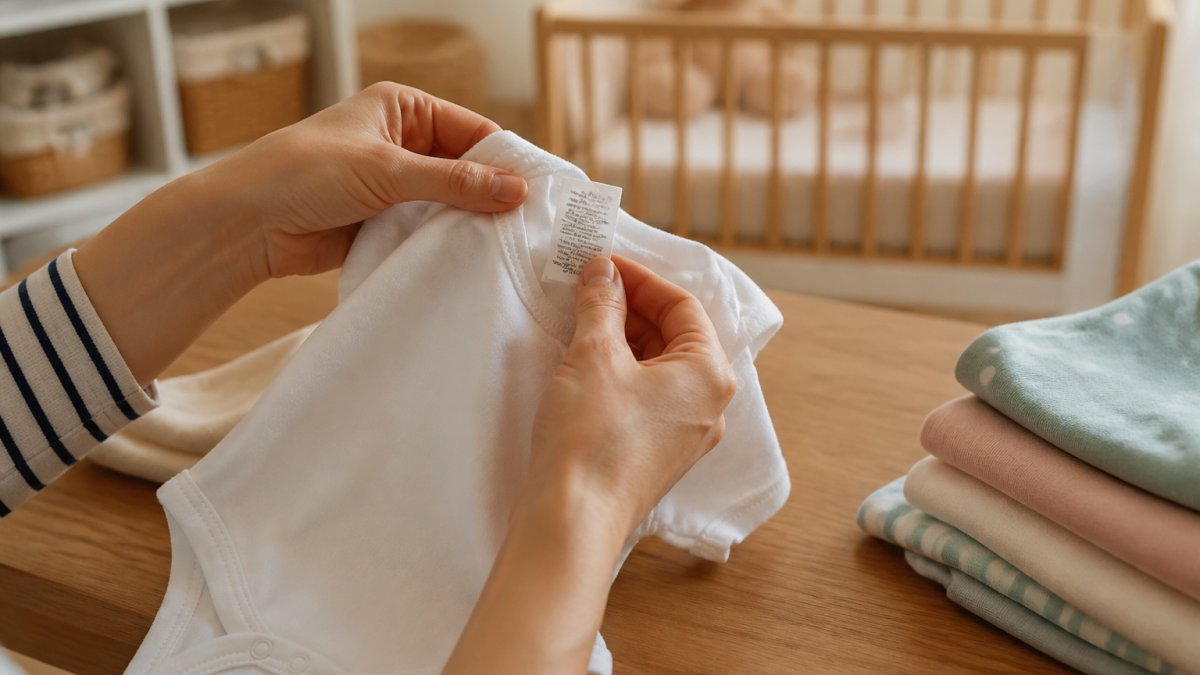
To verify organic baby clothes, start with the label and the certificate, not the product page. Check the fiber content, the certifier name, and the certificate number.
What organic means on a baby clothing label
“Organic” on a baby clothing label should mean the fiber was grown and processed under a certified standard. It is not a regulated word on its own. Without a certifier name and number, “organic” is a claim, not a fact. Once you buy, learn to wash organic cotton baby clothes without shrinking so they last.
Questions to Ask Sustainable Baby Brands About Materials and Supply Chain
The right questions to ask sustainable baby brands get past the slogans. Ask in writing and keep the answers. Vague replies tell you as much as clear ones.
- Which certifier tested this product, and what is the certificate number?
- Where was the fabric made, and where was the garment sewn?
- What chemicals were used in dyeing and finishing?
Material Trade-Offs and Lifecycle Claims Worth Scrutinizing
Every fabric has trade-offs, and honest brands admit them. A single material label is not proof of sustainability. The useful question is not “which fabric is greenest” but “which trade-offs matter for this product and how I will use it.” Lifecycle thinking, sourcing, manufacturing, washing, durability, and disposal, reveals more than any one label.
Material-by-material trade-offs
- Conventional cotton is water-intensive to grow and often relies on pesticides, but it is durable and washes well. Organic cotton reduces pesticide use and has a traceable standard (GOTS), but it still uses water and energy. Readers can browse cotton baby clothes to check fiber content and certifications directly. Neither is automatically better without looking at how the garment is made and how long it lasts.
- Bamboo sounds green because it grows quickly, but most bamboo viscose goes through a chemical-heavy process that can be harmful to workers and the environment if not controlled. Bamboo linen (mechanically processed) is different from bamboo viscose, and brands rarely distinguish them. Shoppers can compare muslin baby clothes to evaluate the actual fabric descriptions. Ask which process was used.
- Recycled polyester diverts plastic from landfills but still sheds microfibers during washing and is not biodegradable. For baby clothing and bedding, microfiber shedding matters because infants are close to fabrics for long periods.
Baby-specific product considerations
Environmental claims and safety claims are not the same thing. For each product type, ask a different question:
- Diapers and wipes: “Biodegradable” or “plant-based” claims often apply to one component, not the whole diaper. Check whether the claim covers the absorbent core, the backsheet, and the packaging, and whether the product has been tested for skin sensitivity.
- Clothing and bedding: Check fiber content, dye and finish chemicals, and whether the certification covers the finished product. Durability matters because a garment that lasts through multiple children has a lower per-use impact.
- Toys: A “natural” wooden toy may use paints or finishes that are not addressed by the material claim. Look for chemical-safety testing and check for small parts and choking hazards separately.
Lifecycle claims worth scrutinizing
A credible lifecycle claim should cover growing or extraction, manufacturing, washing, and disposal, not just one step. Watch for these patterns:
- A claim that covers only the packaging or a single trim.
- A “biodegradable” tag on a mixed-material item that will sit in a landfill.
- A “carbon-neutral” claim with no stated boundary, baseline, or date.
Watch out: a “biodegradable” tag means little if the item sits in a landfill inside mixed materials.
The strongest material claim is specific, bounded, and comparable: it names the material, the process, the lifecycle stage, and the evidence. A claim that only names a material is a starting point, not a conclusion.
A Practical Claim-Checking Checklist for Caregivers
Use this checklist every time a baby brand makes an eco claim. It takes a few minutes and saves a lot of doubt.
- Is the claim specific, or just a buzzword like “natural”?
- Is there a named certifier and a certificate number?
- Did I confirm that number on the certifier’s own website?
What to Do After You Spot a Questionable Claim
Finding a bad claim does not mean giving up on green products. It means switching to brands that show their proof. Ask the brand directly, and check the Consumer Product Safety Commission for recalls and safety notices on baby items. Report clear deception to the FTC.
Then choose brands that publish certificates and name their factories. For a practical starting point, see this list of must-have baby essentials.
Frequently Asked Questions
What are the signs of greenwashing in baby brands?
The clearest signs are vague claims like eco-friendly or natural with no supporting detail, nature-themed imagery that implies certification, and certifications that cannot be traced to a real certifying body. Watch for selective disclosure too: a brand may highlight organic cotton but stay silent on dyes, finishes, or where the product was manufactured. If a baby brand cannot name its materials, manufacturing location, or third-party testing, treat the sustainability claim as unverified until you find evidence.
Are terms like eco-friendly and natural regulated on baby products?
In the United States, terms like eco-friendly, green, and natural are not tightly defined by a single federal standard, so they can appear on packaging with little oversight. Organic is different: agricultural claims fall under the USDA National Organic Program, and textiles labeled organic should be backed by certification. Because the loose terms are not regulated, they are the easiest place for baby brands to make claims that sound meaningful but carry no verifiable standard behind them.
Which sustainable baby product certifications should I look for?
Look for seals you can trace to a named certifying body, then check that the product actually appears in that body’s public database. Common ones parents encounter include USDA Organic for agricultural content, GOTS for organic textiles, OEKO-TEX Standard 100 for harmful substance testing, and Fair Trade certifications for labor. A seal is only useful if you can verify it independently, so search the certification body’s site rather than trusting the logo on the tag.
How can I check whether a baby product is really made from recycled materials?
Ask the brand for the percentage of recycled content and which materials are recycled, since a small recycled trim does not make the whole product recycled. Look for third-party verification such as the Global Recycled Standard, which requires chain-of-custody documentation. If a brand markets recycled materials but cannot state the percentage or point to a certifier, the claim is likely marketing language rather than a verified material fact.
Sorting real eco claims from marketing takes time most parents do not have. That is the problem we built All For Baby And Kids to solve. We focus on eco-friendly materials and thoughtful packaging, and we pick products with comfort and safety in mind. Our curated selection and parent-friendly pricing make it easier to choose well without second-guessing every label. Get started with All For Baby And Kids and shop essentials you can feel good about.
