Last Updated: October 23, 2026
Quick Summary
Non toxic wooden toys for toddlers are made from natural wood, water-based lead-free paint, and food-grade oils or beeswax finishes, with no harmful chemicals that can leach into a child’s mouth or skin. Check that the brand names the wood species, describes the finish, and shares safety testing details before you buy.
- Hardwoods like maple and beech hold up better than soft pine.
- If a piece fits inside a toilet-paper tube, it is a choking risk.
- Wooden toys usually fail at glued joints, thin sections, and paint edges.
- Wipe wooden toys with a damp cloth and mild soap, then dry immediately.
- Rotate toys every couple of weeks so toddlers engage more deeply.
Table of Contents
- Why Non Toxic Wooden Toys for Toddlers Are Worth the Switch
- Safe Wooden Toys for Babies and Toddlers: What to Check Before You Buy
- Wooden Toys With Non-Toxic Paint and Natural Finishes
- Montessori Wooden Toys for Toddlers: Open-Ended Play That Grows
- Eco-Friendly Toys for Toddlers: What Sustainability Really Means
- Toddler-Specific Choking, Breakage, and Supervision Guidance
- How to Clean and Care for Wooden Toddler Toys
- Conclusion
- Frequently Asked Questions
Why Non Toxic Wooden Toys for Toddlers Are Worth the Switch
At All For Baby And Kids, we hear the same question from parents every week: how do I know what’s actually safe for my toddler to chew on? It’s a fair worry. Toddlers explore the world with their mouths, and non toxic wooden toys for toddlers solve a problem plastic can’t. They’re made from natural materials, finished without harsh chemicals, and built to survive years of drops, throws, and teething sessions.
The switch isn’t about being trendy. It’s about knowing exactly what’s in your child’s hands.
What Makes a Wooden Toy Non-Toxic
A wooden toy is non-toxic when its wood, paint, and finish contain no harmful chemicals that can leach into a child’s mouth or skin. That means untreated or safely sealed natural wood, water-based paints, and finishes free of lead, BPA, and phthalates.
Here’s what actually matters:
- Wood type: Hardwoods like maple and beech hold up better than soft pine
- Finish: Food-grade oils, beeswax, or water-based sealants
- Paint: Water-based, lead-free, and labeled as such
- No hidden adhesives: Cheap glue can off-gas or break down
The label “natural” means nothing on its own. Look for specific material disclosures instead.
Safe Wooden Toys for Babies and Toddlers: What to Check Before You Buy
Before you add anything to your cart, check four things: material disclosure, finish type, age rating, and construction quality. If a brand can’t tell you what the wood and finish are, that’s your answer.
Run through this checklist:
- Wood species is named (maple, beech, rubberwood)
- Paint or finish is described as water-based or food-grade
- Age range matches your child’s stage
- No loose parts, splinters, or exposed screws
- Brand publishes safety testing information
Most parents skip the last one. Don’t. A brand that shares testing details is a brand that has nothing to hide.
Toy Safety Standards and How to Verify Compliance
In the United States, children’s toys fall under mandatory federal safety rules enforced by the Consumer Product Safety Commission. These cover lead content, small parts, and choking hazards. Reputable makers test against these standards and often add third-party lab verification.
Ask the brand directly:
- Which standard did you test against?
- Who performed the testing?
- Can you share the report or a summary?
A trustworthy maker answers all three. Vague replies like “our toys are safe” tell you nothing.
Wooden Toys With Non-Toxic Paint and Natural Finishes
Paint and finish are where most hidden risks live. A beautifully painted block is only as safe as what’s in the coating. Non-toxic options split into two camps: water-based paints and natural oil or wax finishes.

Water-Based Paint vs. Natural Oil and Wax Finishes
Water-based paint gives you color without solvent fumes. It’s the safer choice when you want bright, playful designs. Natural oils and waxes, like food-grade mineral oil or beeswax, leave the wood grain visible and give a smooth, splinter-free surface.
Here’s the trade-off:
| Finish Type | Best For | Watch Out For |
|---|---|---|
| Water-based paint | Colorful blocks, puzzles | Confirm it’s lead-free |
| Beeswax and oil | Teethers, stacking rings | Needs occasional re-oiling |
| Untreated wood | Chewing, sensory play | Check for splinters |
For teething toddlers, an oiled or untreated natural finish is usually the safer bet. Paint chips. Oil doesn’t.
Montessori Wooden Toys for Toddlers: Open-Ended Play That Grows
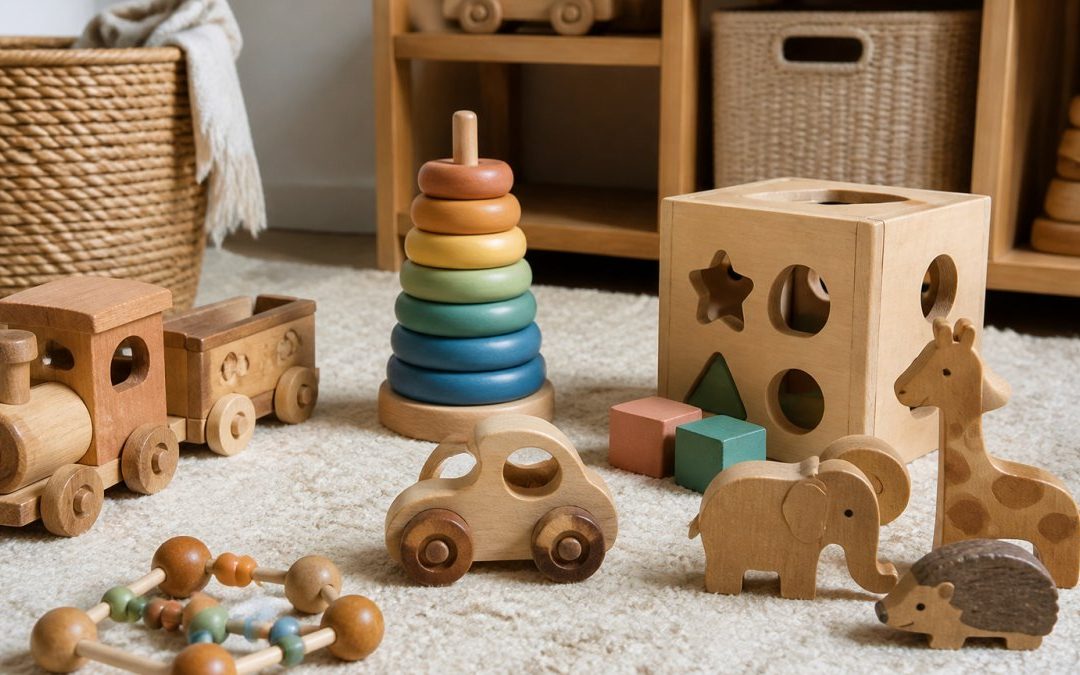
Montessori wooden toys for toddlers are built around open-ended play, meaning there’s no single “right” way to use them. A set of wooden blocks can become a tower, a road, or a pretend meal. That flexibility is the point.
Why parents love this approach:
- Grows with your child: The same toy works at 18 months and 3 years
- Builds fine motor skills: Grasping, stacking, and sorting
- Encourages creativity: No batteries, no preset outcomes
- Lasts longer: Fewer pieces to outgrow
A simple stacking toy teaches size and balance. A set of wooden stones becomes a landscape. Fewer toys, more play.
Rotate toys every couple of weeks instead of leaving everything out. Toddlers engage more deeply with a small, rotating set of open-ended wooden toys than with a crowded toy bin.
Eco-Friendly Toys for Toddlers: What Sustainability Really Means
Eco-friendly toys for toddlers should be sustainable at every stage: the wood source, the finish, the packaging, and how long the toy lasts. Sustainability isn’t a sticker on the box. It’s a chain of choices.
What to look for:
- Sustainably sourced wood: FSC-certified or reclaimed timber
- Minimal packaging: Recycled or plastic-free materials
- Durability: A toy that lasts five years beats one replaced every season
- Local or small-batch production: Shorter supply chains, less waste
At All For Baby And Kids, our focus on eco-friendly materials and thoughtful packaging comes from the same place: fewer chemicals, less waste, and toys that hold up to real family life. You can read more about sustainable toy sourcing if you want to check a brand’s forestry claims.
Toddler-Specific Choking, Breakage, and Supervision Guidance
Even the safest wooden toy needs supervision, but “supervise” is not a plan. Toddlers between about 12 and 36 months are in a specific developmental window: they mouth objects to explore, they have not yet developed a reliable gag reflex for every shape, and they are strong enough to twist, drop, and stomp a toy in ways a baby cannot. That combination is why toddler-specific guidance matters more than general toy safety advice.
The Small-Parts Rule in Practice
The federal small-parts requirement exists because young children choke on objects that fit through a specific opening. For a toddler, the practical version is simpler: if a piece can come off and fit inside a cardboard toilet-paper tube, it is a choking risk. That includes:
- Removable pegs, knobs, and wheels
- Glued-on eyes, noses, and decorative pieces
- Small magnetic pieces and loose beads
- Broken-off corners from thin or brittle wood
For children under three, skip toys with small removable parts entirely. A toy marketed as “3+” is telling you something about its small parts, not just its difficulty.
Why Wooden Toys Break, and Where
Wooden toys usually fail at the joints, not the wood itself. The common failure points are:
- Glued joints: Cheap glue dries out, and a glued peg can pop loose under a toddler’s twist.
- Thin sections: A thin axle or a narrow neck is where a toy snaps first.
- Paint and finish edges: Chips start at corners and edges, which is exactly where a teething toddler puts their mouth.
- Screws and inserts: An exposed screw head can work loose, and a stripped insert leaves a hole that collects moisture and weakens the wood.
Solid, single-piece construction with no glued-on small parts is the sturdiest choice for a toddler. Where a toy does have joints, look for through-tenons, dowels, or mechanical fasteners rather than glue alone.
A Five-Second Inspection You Will Actually Do
Before every play session, run this routine:
- Squeeze and twist the main body and any attached parts. Anything that moves or creaks is a candidate for retirement.
- Run a thumb along every edge to feel for splinters, rough spots, or lifted finish.
- Check the paint at corners for chips or peeling, especially on teething toys.
- Look for loose screws or pegs and tighten or remove the toy if they will not stay put.
- Drop it from waist height onto a hard floor. A toy that cracks or sheds pieces on a normal drop is not toddler-durable.
A toy that passed inspection last month can fail today. Wood dries and shrinks with humidity changes, glue weakens, and paint chips. The five-second squeeze-and-twist test before handing any wooden toy to a toddler is the single highest-value habit in this article.
Supervision That Matches the Stage
Supervision is not the same at 12 months and 30 months. A few stage-specific notes:
- Around 12-18 months: Mouthing is constant. Choose unpainted or oiled teething toys, and keep anything with small parts out of reach entirely.
- Around 18-24 months: Toddlers start stacking, dropping, and throwing. Check joints more often, and prefer single-piece construction.
- Around 24-36 months: Pretend play and sorting emerge. Small loose pieces become more appealing, so match the toy to the age rating and keep the smallest pieces stored separately.
For the official small-parts guidance, the CPSC’s guidance on small parts and choking hazards is worth a quick read before you buy. The short version: match the toy to the age rating, not to your child’s height or vocabulary.
How to Clean and Care for Wooden Toddler Toys
Wooden toys need gentle cleaning, not a soak. Wipe them with a damp cloth and mild soap, then dry immediately. Never submerge wood in water, because it swells, cracks, and warps.
A simple routine:
- Wipe daily with a damp cloth
- Wash weekly with mild soap and a barely damp rag
- Dry fully in open air
- Re-oil natural finishes every few months
- Inspect for splinters and chips monthly
Avoid bleach, harsh cleaners, and the dishwasher. They strip finishes and shorten a toy’s life. For teething toys, a food-grade oil refresh keeps the surface smooth and safe.
Conclusion
The hardest part of buying safe toys isn’t finding wooden options. It’s cutting through vague labels to know what’s actually in your toddler’s hands. Check the wood, the finish, and the testing details, and you’ll choose well every time.
At All For Baby And Kids, we’ve built our toy selection around that same standard: carefully researched product guidance, eco-friendly materials, and parent-friendly pricing. Our curated range of wooden toys and essentials is designed to support your child’s safety and happiness from the first chew to the first block tower.
Frequently Asked Questions
What makes a wooden toy non-toxic?
A non-toxic wooden toy uses untreated or responsibly finished natural wood, plus paints, oils, and waxes that are free of lead, BPA, phthalates, and heavy metals. Look for water-based paints, food-grade mineral oil, or beeswax finishes. The toy should also meet US toy safety standards and carry a clear age recommendation. If a brand cannot tell you what finish it uses, treat that as a red flag and keep looking.
Are wooden toys safer than plastic toys for toddlers?
Wooden toys avoid some plastic concerns, such as phthalates and BPA, and they tend to be more durable, so they break into fewer small parts. That does not make every wooden toy automatically safe. Painted finishes, loose parts, and cracked edges all matter. Choose solid hardwood, non-toxic finishes, and age-appropriate sizing, then check the toy regularly for splinters or loose pieces before your toddler plays.
How can I tell whether a wooden toy is safe for a toddler?
Check three things: the material, the finish, and the size. Solid hardwood with a smooth sanded surface is a good start. Confirm the finish is water-based paint or a natural oil and wax, not a solvent-based lacquer. For toddlers under three, every piece should be larger than a choke-test cylinder, with no detachable small parts. Also look for a US safety certification mark and an age label on the packaging.
How do I clean and care for wooden toddler toys?
Wipe wooden toys with a damp cloth and mild soap, then dry them right away. Skip the dishwasher and never soak them, because water swells and cracks the wood. For deeper cleaning, use a diluted white vinegar solution and dry fully. Re-oil unpainted wood every few months with food-grade mineral oil or beeswax to keep it from drying out. Inspect for splinters and loose joints each time you clean.
Choosing safer toys shouldn’t feel like detective work. All For Baby And Kids makes it simpler with a curated selection of eco-friendly wooden toys, transparent material guidance, and quick, secure shipping. Browse our collection and find the right non toxic wooden toys for your toddler’s next stage.
